
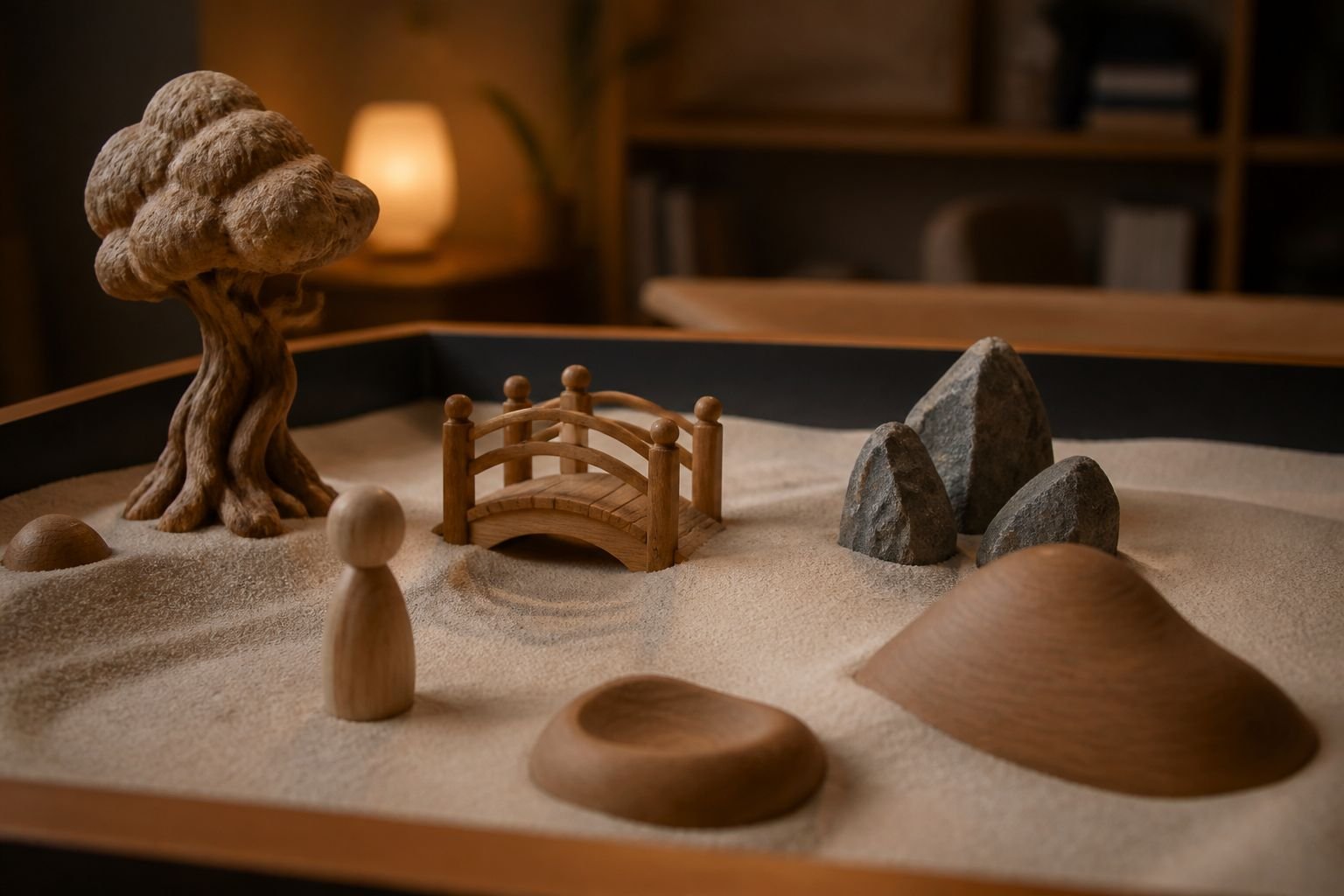
Sandplay offers a tray of sand and a collection of figures, so that what cannot yet be spoken can still be shown.
Some experience lives in narrative. You can tell it, more or less, and the telling itself begins to order what was chaotic. Other experience lives elsewhere — in the body, in image, in a tightness that has no plot. When words are not yet enough, insisting on sentences can become another kind of pressure. Sandplay is one way of letting the psyche speak in its own language first.
A tray of sand. A collection of figures: animals, houses, trees, people, stones, strange small objects that have no obvious job. You are invited to make a scene, or not. There is no right way. You may build, rearrange, sit with what appears, or say nothing at all. I stay with you as the scene finds its own order.
People sometimes worry that they are not artistic, or that they will do it wrong. Sandplay is not art therapy in the sense of producing something to be judged. It is a symbolic way of working. The tray becomes a temenos — a protected space — in which the unconscious can arrange what the talking mind cannot yet hold.
This can be especially helpful after trauma, in grief, in depression that has gone wordless, or when childhood material returns without a story attached. It can also simply be a relief: to stop explaining yourself for fifty minutes and let your hands do something true.
I do not interpret the scene over you like a puzzle to be solved. Meaning, when it comes, tends to come from you — a recognition, a feeling, a memory that was waiting. My work is to keep the space, to notice with you, and not to hurry the image into a conclusion it has not chosen.
Sandplay is optional. It is never required. Some clients never use the tray. Others find it becomes a regular part of the hour, a third presence in the room. We decide together, as we decide everything else: according to what serves you, not a method for its own sake.
If you are curious, we can talk about it in a session. You do not need to prepare. You only need to be willing to see what wants to appear — and to trust that not everything that heals has to be said out loud first.
Bring all of who you are, including the parts that do not yet have language. The tray can hold them until they do.